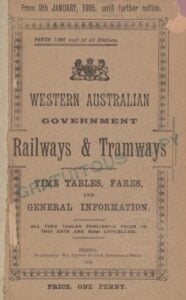
One of the things I enjoy about writing historical nonfiction is doing the research. Reading books and old newspaper articles, tracking down dates and biographical information, hunting for small details such as a train timetable and visiting the State Records Office to look at yellowing documents are great ways to lose all sense of time and current concerns.
OneNote notebooks
Managing the information I collect is another matter. It’s easy to lose track of where it came from or where I’ve put it. So I’ve had to develop a system of sorts. I mostly use OneNote, a Microsoft Office app, to record my research findings and make a note of the source. OneNote allows me to organise information within my notebooks into sections, pages, and subpages, which are then searchable.
I like to have a separate notebook for each project. As I go along, I create a section in the notebook for each main character, along with anything that seems like an important topic. When I was working on The Edward Street Baby Farm, I had a section for “Background” that included pages for “sewage” and “teething”!
If I download documents or images, I can add a link in OneNote to the folder where I’ve stored them. The same goes for photos I’ve taken in my on-the-ground research. I can also clip stuff directly from the internet into the relevant section or page, with a link back to the website, and any notes that I want to add. (No affiliate disclaimer needed here – Microsoft isn’t paying me for this. )

Spreadsheet timelines
Before I start writing, I need a way to feed my accumulated research into some sort of timeline. At the suggestion of several other non-fiction writers, I use a spreadsheet to do this. But it’s really just a very large table.
The first column is for dates. Then there’s a column for relevant major events that fall within the time-frame of the book, such as Federation or the completion of the Supreme Court building. Next I have columns for each of the main characters, and another for “others”.
I put the major events in first, inserting a row for each one so that the dates remain in sequence. An online timeline such as the one at WA Now and Then proves useful for this. Then I start adding information for each person, again inserting rows in the right place for the date on which things happened. When I’m finished, I have a timeline that might have ten year gaps between dates in some places, but rows for every day during something like the court case in the middle of the Edward Street story.
This gives me a visual reminder of the chronological order of events and helps me to write them in a logical way. It lets me see what each person was doing at a particular time. I can also see co-incidences and connections between events and people that wouldn’t be obvious otherwise.
I still sometimes find myself wondering “Now, where did I see that news item about the crowd outside the police courts?” or “Where did I put the information about sherry whey?” I continue researching while I’m writing as I discover gaps that need to be filled in. But overall, it’s a system that works for me.