Work on my next book has been progressing quite slowly recently. Not that I haven’t been putting in the time at my desk. But after finishing the first draft I felt that it needed to be re-organised. Some of the longer explanatory sections needed to be broken up, or even cut altogether, to let the story come through better. In some places I needed more information, and new information that has already come to light also had to be incorporated. At the moment it feels like I’ve got most of the wood sawn to size, but I’m not quite sure how it all fits together to make a table, or what the nails are that will hold it together.
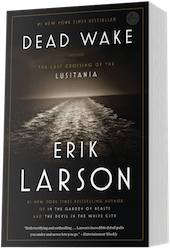 My muse for the sort of narrative non-fiction I’m writing would have to be Erik Larson, author of “Dead Wake“, “The Devil in the White City” and “In the Garden of Beasts“. I love the way he turns research about historical events into stories that make you want to keep turning the page to see what happens next. Even if, as in the case of “Dead Wake”, about the sinking of the Lusitania, you already know what the result will be. I’m awed by the way he brings people and settings to life, and adds details that make his books as vivid as novels – “novels with footnotes”, as someone described them.
Recently I read through several interviews with Larson, hoping to discover some clues as to how he achieves this. His first step, I learned, is to do huge amounts of research, including looking for small incidental details that help provide authenticity. No matter how tempting it might be, he never adds anything to his stories that he can’t provide a reference for. The research can take him a couple of years. He logs everything onto a timeline that not only helps him to see the connections between events, but also acts as an outline for his first draft.
As soon as he feels he’s ready, he begins writing, but goes on researching as he writes. That’s reassuring to someone who stops mid-sentence to look something up. It was also encouraging to read that it takes him three to four years to finish a book, and he might rewrite his first draft eight or nine times. By that standard I’ve got a few drafts to go yet before I put the final polish on the table.