‘A journalistic, musical, dramatic and social power‘ in his adopted home town, Perth. That was how a Melbourne newspaper article described Francis Hart in 1894. Francis quite likely wrote the article himself. Yet the description was not too wild an exaggeration. During the 1880s and 1890s, Francis had a spoon in every pot in the social life of the Swan River Colony, and he liked to keep them stirred.
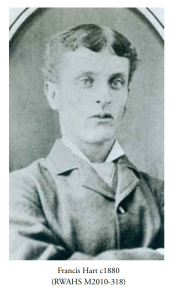
Francis Jerome Ernest Hart (as he was known at the time) first made a name for himself in Western Australia as a prolific jounalist and writer. He briefly edited the conservative West Australian newspaper. But he also wrote for the more satirical Fremantle Herald. For several years he was editor of the Victorian Express, based in Geraldton. He and his newspaper had an opinion, often radical, on everything.
In time, Francis also became well known as a performer and musician. He wrote, produced and acted in plays and operettas, including one which he co-wrote with the colony’s governor, Sir William Robinson. With his wife Lilian (a talented musician and writer in her own right) he appeared on the invitation list of almost every important social event in Perth and Fremantle. His wit, his creativity, and his energy made him a popular guest.
Francis was an entrepreneur who dabbled in politics. For a while, he acted as secretary to the Chamber of Commerce in Perth. Towards the end of his eighteen years in the colony he became a keen promoter of its economy and the developing mining industry. He left Perth in 1896 with the avowed intention of setting up a ‘bureau of information’ for Western Australia in London.
Unfortunately, managing his own money was not Francis’ strong point. In his early years in the colony he was charged with obtaining money under false pretences. Twice he went bankrupt. But his huge self-confidence helped him bounce back unscathed.
Francis could be impetuous and fickle. In 1905 Lilian would divorce him, after accusing him of unfaithfulness, exploitation and abandonment. But by then both had left Western Australia. The colony remembered Francis mainly as a man short in stature but towering in vitality, ingenuity and self-assurance.
My introduction to Francis
I first came across Francis Hart while researching my book, Madness and Marvels. His name often apppeared alongside that of one of the main subjects of the book, Dr Henry Barnett, in reports of musical, literary and social events. Lilian Hart (nee Mitchell) I soon discovered, was the niece of Henry’s wife Emily.
Probing the background of a minor player in a story often reveals interesting information or helpful clues about the main characters. So although Francis didn’t play a key role in the book, I still thought it worthwhile to find out more about him.
Francis claimed to be the son of Dr Ernest Abraham Hart, a well known English doctor, editor of the British Medical Journal, writer and social reformer. Based on Francis’ stated age when he arrived in Perth, he was born about 1857. Some online family trees list him as the son of Dr Hart’s first wife, Rosetta Levy. But despite an extensive search, I couldn’t find any child named ‘Francis Hart’ born in England in the relevant period with Levy registered as the mother’s maiden name.
Ernest Hart married Rosetta in 1859.1 She died childless, in rather strange circumstances, in 18612. Dr Hart’s second wife, Alice, who outlived him, was also childless. Obituaries for Dr Hart, who died in 1898, stated that he left no children.
An imposter?
My suspicion that Francis might have been an imposter grew when I contacted the archivist at Queen Elizabeth School in Ipswich, England, which he claimed to have attended. It seemed the school had no record of Francis Ernest Hart, or anyone of similar name, enrolled as a student. (I’ve since learned that the school doesn’t have admission records for students before the 1890s). I couldn’t find Francis’ name among the students resident at the school in the 1871 census.3 Nor did Francis appear to be a graduate of London University, as he later claimed.
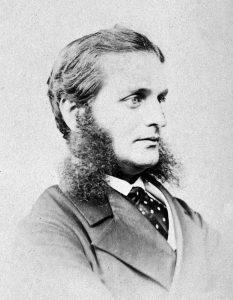
Yet Francis certainly bore a strong resemblance to Dr Ernest Hart in photos. Apart from the facial similarity, both were described as being short, and both were noted for their great energy. They both had broad interests and were talented writers. Could Francis have been an unacknowledged son of the famous doctor?
I tried to trace Francis in the years before he came to Western Australia. He arrived in Albany as a twenty-year-old in September1878, aboard the SS Siam, which was carrying mail from Melbourne to London. Shipping records showed that he had boarded the Siam in Melbourne.
But although the Public Records Office of Victoria (PROV) site had many entries for people named Francis Hart, none could definitely be tied to the person I was looking for. Nor did he make it into the Melbourne newspapers – at least not as Francis Hart.
A similar brick wall appeared when I tried to track him after his divorce from Lilian in London in 1905. West Australian newspapers briefly mentioned him having gone to Spain and to the United States. An article in 1933 made a passing reference to ‘the late Francis “Cocky” Hart‘. But I couldn’t discover any clear record of his death. It seemed he had appeared from nowhere and disappeared into thin air.
Since he was a minor player in the book I was working on, I left it there. But recently I decided to make another attempt to find out where this enigmatic character came from, and where he finished his life.
Hidden in prison
Once again I tried working backwards from his arrival in Albany in 1878. This time I was in luck. Putting ‘Francis Jerome Ernest’, without the surname Hart, into the PROV search engine took me to an 1876 prison record for Ernest Jerome FRANCIS (Francis being the surname). The record included many useful details, including the fact that the nineteen-year-old man was quite short, at 5 feet 4 inches, and lightly built. He was single, born in London in 1858, and a teacher by profession.
The entry in the prison register noted that he’d travelled to Melbourne from London aboard the Wakatipu, a fact confirmed by the ship’s passenger list. He had no relatives in the colony. Since the prison register gave the date and place of his trial, I was able to look up the details in the newspapers on Trove.
Ernest Jerome Francis had been employed as a teacher at Daylsford Grammar, but his time at Daylesford had been quite brief. He arrived in Melbourne in September 1876. By 3 January 1877, he had been arrested for forgery and appeared in the Daylesford Police Court. It seems he had signed the head teacher’s name on several cheques, to the sum of fifteen pounds, while the head was away in Melbourne.
At his trial at the Castlemaine Assize court on 12 February, Francis pleaded guilty. Reading from a prepared statement, he expressed sorrow ‘for the grief his situation must cause to all those connected to him’. He asked the judge for consideration of his trying circumstances.
Justice Stephen was moved but not convinced. After saying it was painful to see a young man in such a position, he sentenced him to two years in prison with hard labour. Francis was removed to Pentridge prison in Coburg. near Melbourne. He remained there until his sentence was remitted on 29 August 1878.
New colony, new name
For someone described by the newspapers as ‘a genteel young man’, his release must have come as a welcome end to a dreadful experience. With a prison record, he had no hope of finding work in Victoria. So five days after his release, it appears he headed for Western Australia aboard the SS Siam. This time he called himself Francis Ernest Jerome Hart.4
No doubt Francis told his prospective employers in Perth, quite truthfully, that he had previously worked as a teacher. This, and his claim to have been educated at London University, probably helped earn him a post as a master teaching French at the Government High School for Boys. He probably didn’t mention the eighteen months he had just spent in Pentridge.
Francis may have rearranged his name, but he hadn’t changed his character. In 1882 he was charged with two separate instances of obtaining money under false pretences by presenting a valueless cheque. This time he had a lawyer to defend him and he was acquitted. He had another brush with the law in relation to a dishonoured bill in April 1883. Although these cases are not identical to the forgery in Daylesford, they are similar enough to suggest they involve the same person.
A death in Manhattan
Now that I almost certainly had the date that Francis arrived in Melbourne, the ship on which he travelled, and a year of birth (assuming he was telling the truth about his age) I was hopeful that I could trace him back to his birth in London. But once again he proved impossible to find.
I decided to go in the other direction. What happened to him after his divorce in 1905? The story about him going to America seemed a good place to start. Trying various combinations of names for Francis on the familysearch.org search engine led me to a death certificate for ‘Ernest Jerome Hart’, in Manhattan, New York, on 13 August 1927.
Hart was described as a white male, aged sixty-six, single, born in England and resident in the US for five years. He died from stomach cancer.
There are obviously a few discrepancies here. Francis Hart would have been sixty-nine in 1927. He was divorced, rather than single. And if he was already in the US in 1919, as suggested by a West Australian mention, he would have been resident for much longer than five years. He could, of course, have travelled there more than once.
Two things convinced me that Ernest Jerome Hart was actually the same person as Francis Hart of West Australian fame. One was a brief obituary in The Musical Leader, an American magazine. It described him as ‘Captain’ Ernest Jerome Hart and referred to his early career with the British Military. This was a bit off-putting. Francis Hart had no military career that I know of. But the writer described ‘Captain Hart’, an Englishman, as a widely known writer on musical subjects, with articles in musical publications throughout the world. This sounded more like Francis.
Then it mentioned that he had been ‘attached to the staff of the Governor General (sic) of West Australia’. This detail, while inaccurate, seemed too much of a co-incidence. Could this have been a story elaborated by Francis, or perhaps a muddled recollection by the writer?
The importance of being Ernest
The second convincing piece of evidence came from the death certificate itself. It provided Ernest Jerome Hart’s mother’s name – Isabel Telfer – along with his father’s name, Ernest Hart (both said to be English). This led me to a birth record for Ernest Francis Hart, born in Marylebone, London in 1857, with mother’s name Telfer.
The birth, on 15 October, had been registered by the mother, Isobella Mary Telfer. She described herself as the wife of Ernest Alfred Hart, a dentist. She was living at 9 Stafford St, Marylebone.
I’ve been unable to find any recorded marriage for a couple with surnames Hart and Telfer. Nor can I find any dentist in London around this time named Ernest Hart. Dr Ernest Abraham Hart, who lived in Marlylebone, was an eye surgeon before he became editor of the Lancet and then the BMJ. But his brother James and his father, Abraham Septimus, were both dentists. Perhaps this inspired Isobella to construct her imaginary dentist husband. Or perhaps Ernest had lied to her about his profession.
If Isobella hoped that one day Ernest would make her his wife, she was to be disappointed. By the time of the 1861 census, Ernest had married to Rosetta Levy. Isobella M. Telfer, a dressmaker, was still living with her mother, Elizabeth, in Marylebone, London. Newspaper reports suggest that her father, Adam Telfer, had abandoned her mother several years earlier, leaving the family in poverty.(Given Francis Hart’s later behaviour towards his wife Lilian and his own daughter, this is an ironic detail.)
Young Ernest Francis Hart wasn’t with Isobella in 1861. In fact, I haven’t been able to find any trace of him in that census. But in 1871, Isobella M. Telfer, dressmaker, was a boarder at a house occupied by a tailor and his family in Paddington. Alongside Isobella’s name on the census is that of another boarder, ‘Ernest F Heart’, aged 13.
Some of this is circumstantial evidence,. But I’m satisfied that the Ernest Jerome Hart who died in Manahatten in 1927 was the Francis Jerome Ernest Hart who enlivened the Swan River colony in the eighteen eighties and nineties. Despite all his other stories, I now believe he was actually telling the truth when he claimed to be the son of Dr Ernest Hart.
Unanswered questions
There are still many unanswered questions about Francis Hart. How did he spend his childhood? He seems to have had a broad education which included music and French. If he didn’t attend Queen’s School Ipswich or London University, where did he go to school?
And what was he doing prior to the day in July 1876 when he boarded the Wakatipu, bound for Melbourne? The change of name before travelling suggests he might have been in some sort of trouble. Or perhaps his mother’s marriage in 1874 was the catalyst for him leaving.
His claim to be Dr Ernest Hart’s son when he arrived in Perth seems risky. Most medical men in Perth at the time had trained in England. It was quite possible that someone would have been familiar enough with Dr Hart to know he didn’t have any children, at least officially.
Yet no-one in Western Australia seems to have questioned Francis’ claim, even after the doctor’s obituary appeared in 1898. Many men came to the Swan River Colony to escape their own difficult past. Perhaps there was an unspoken agreement not to call anyone out. Or perhaps Francis ‘Cocky’ Hart simply charmed them all.
Footnotes
- Many biographies of Dr Hart online say that he and Rosetta were married in 1855. However, none give a reference for this date. Their marriage was officially registered with the UK General Registry Office in 1859. One of Dr Hart’s obituaries also mentions that they had only been married a couple of years when Rosetta died. ↩︎
- Rosetta died from accidentally ingesting a dose of the wrong medicine. Rumours spread that her husband had deliberately poisoned her, but the Coroner’s Court upheld the verdict of accidental death. See Ernest Hart: Editor of the British Medical Journal 1866–1898 – PMC ↩︎
- The census was taken not long before Easter that year, so possibly the school was in recess. ↩︎
- Although the names Ernest and Francis were both fairly common at the time, Jerome was not. The combination of all the three is quite unusual. I can only find two people in Australia in this era with all three names, using a broad search of records and newspapers. They are the forger in Victoria and Francis Hart in Western Australia. ↩︎
Hi Stella, we need to cha, viz. Francis Hart. Brendan Kelly